.png?width=200&height=59&name=IPTellogo-byline-2020-dark-v2-pnd-optimised-500%20(1).png "IPTellogo-byline-2020-dark-v2-pnd-optimised-500 (1)")
Services
Wi-Fi Surveys
Wi-Fi Surveys are at the core of every successful Wireless installation.
For so many businesses, Wi-Fi has become a critical component of the business - that leaving the Wi-Fi design to chance is just too much of a risk.
At IPTel we have designed hundreds of large and critical sites - your Wi-Fi design is safe in our hands.
We can take you from first principles to a design that will support your business - no matter your use case. If your office, warehouse, university, hospital or any other type of site needs a professional Wi-Fi design, we can help.
 .
.
IPTel Solutions
Contact Us

Wi-Fi that Works!
Our tag line at IPTel is Wi-Fi that Works! We build Wi-Fi that delivers for your business. A Wi-Fi design follows some stages to be designed and built correctly.
The design stage for Wi-Fi typically follows a two stage process:
- Predictive RF Design
- Pre-Deployment Survey
One the design is built - we then move onto the Deployment Validation stage.
Wi-Fi is also designed specifically for many types of business and deployment scenario:
Aged Care Wi-Fi
Aged Care Wi-Fi needs to support a range of use cases. The staff are mobile and increasingly need to be able to use mobile devices, such as tablets and smart phones.
The residents want to be able to connect Netflix, internet and communicate with their relatives over video calls.
Technology has a role to play, and greatly helps to improve the lives of everyone in the aged care sector. Ease of use, guest access and support for voice and location tracking are all key.
Associated Blogs:
Hospital & Clinical Wi-Fi
The first consideration for hospitals is the big one - what do you actually want to do with your network? There's so many use cases in a hospital to consider.
Installing a clinical grade Wi-Fi network if no small investment, so it pays to make the early decision on what you actually want to do with the network. There's a range of options:
- Patient Guest Access
- Corporate Laptops
- iEMR
- Voice
- Duress & Location Services
- Biomedical
- BEMS, Sensors, IoT
Clinical networks need to ensure one thing above all others: reliability.
Associated Blogs:
Hotel & University Wi-Fi
Hotels, hospitality, universities and schools have one thing in common: lots of people that want to use great Wi-Fi!
Have you ever stayed in a hotel and the Wi-Fi wasn't great? I'll bet the answer is an unqualified yes - we can design Wi-Fi that works.
Universities and schools rely on very high spec networks in their teaching spaces and the wireless network is an important part of that fabric.
Hospitality and education have increasingly high demands on their Wi-Fi networks, so designing these for their individual use cases is where IPTel can help.
Associated Blogs:
Industrial Wi-Fi
IoT is not just about end-user Wi-Fi connected devices, but a wealth of industrial, ruggedised devices, designed to be used in an industrial setting.
IOT equipment is used across a wide range of verticals - from mining, utilities, transport, warehouse and manufacturing.
Industrial Wi-Fi has to be designed to meet many use cases, sometimes with very exacting standards, such as vehicle automation.
In designing for industrial Wi-Fi, we need to take great care of not just the RF design - but how we physically mount the access points.
Associated Blogs:
Retail & Warehouse Wi-Fi
Retail stores are where retailers interact with customers. It's where a lot of sales are made - and lost - and an area that retailers are keen to put a lot of effort into, to enhance the customer experience.
Retail Warehousing is going through a revolution currently. There are many more robotic and automated warehouses in the pipeline, especially for supermarkets, where the supply chain is so important and critical for everyone.
Wi-Fi designs are specific to both these use cases and are built to meet the customer and end-user requirements.
Associated Blogs:
Stadium Wi-Fi
Stadiums are tricky places to design and deploy Wi-Fi. Seating arrangements change, densities of the crowd and the use of the space all have to be accommodated in the design.
Add to this the difficulty of where to actually install an AP and you need to have some handy tricks up your sleeve - such as specific access points built for the stadium space.
Stadiums are one of the most complex and challenging Wi-Fi designs, but we have a wealth of experience to take the risk out of stadium Wi-Fi designs.
Associated Blogs:
Wi-Fi Predictive Design
Wi-Fi Predictive Design is all about using RF design software to produce a valid layout of Access Points (APs). Sometimes also called a 'desktop survey' the predictive design is a model of the environment, used to test the designs out.
The floor maps are imported into the design software (we use Ekahau Site Survey) and the following undertaken:
- Map Scaling: The maps are scaled for accurate size - the means the RF coverage patterns are accurate to the real world
- Wall Drawing: All the walls are drawn in, on the software, with appropriate attenuation settings selected
- Design Layout: The APs are placed into the design, and the RF output simulated. Iterative adjustments are made at this stage
- Checks and Balance: A set of pre-defined checks and balances are used to ensure AP density and placement are correct for the Wi-Fi use cases to be supported, as well as the environment
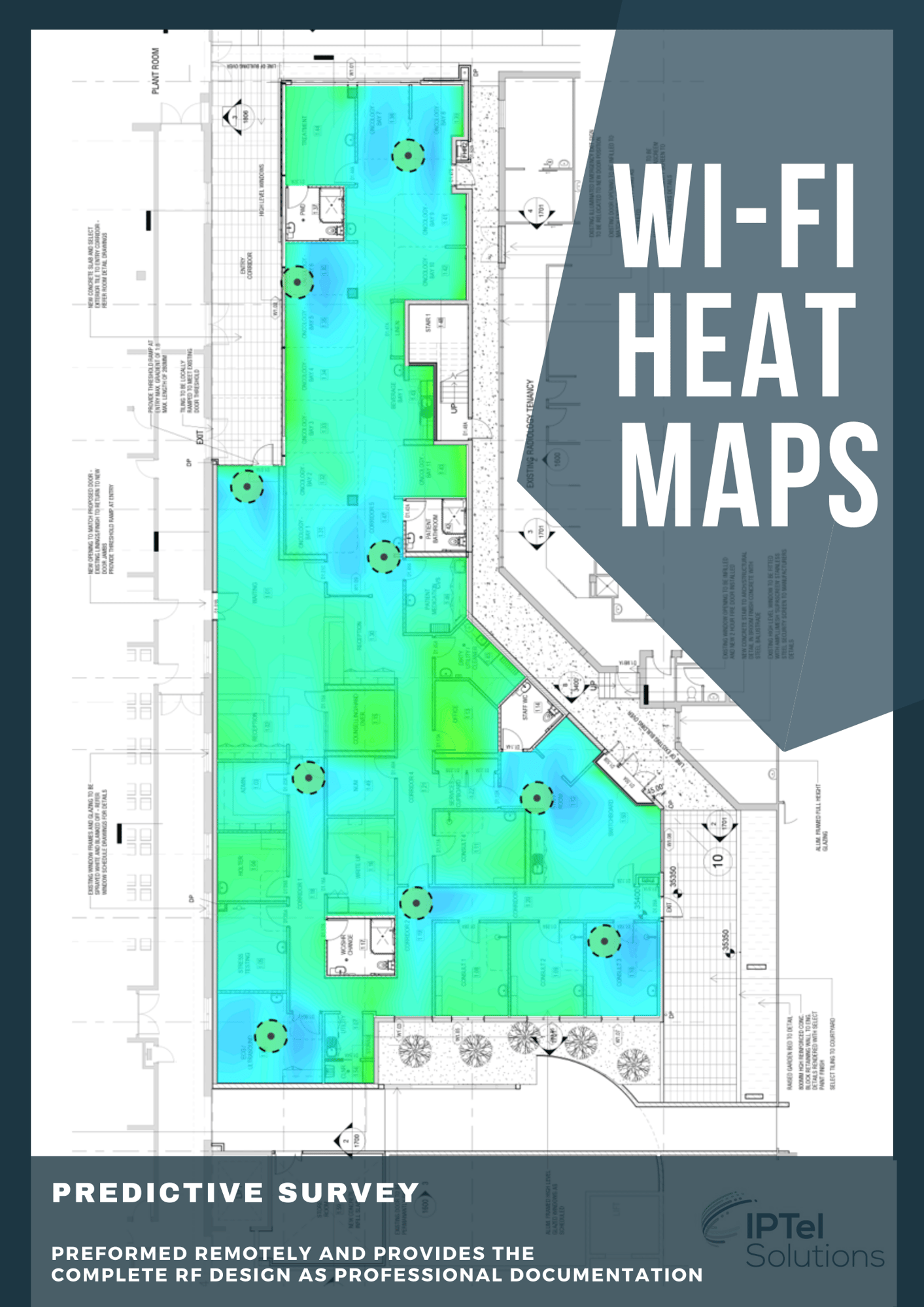
Wi-Fi designs can be just a predictive survey, but for an accurate result we like to attend your site to sample the actual wall attenuation.
This real world data can then be integrated with our predictive design - this makes the result very accurate. We typically recommend the pre-deployment survey for complex environments: hospitals, warehouses and industrial sites being key examples.
Wi-Fi Pre-Deployment Survey
The pre-deployment survey is the second stage of the design phase. This is also known by the names of 'Pre-Install Survey" or "AP-on-a-stick" survey.
The survey seeks to test the design, with the following methodology:
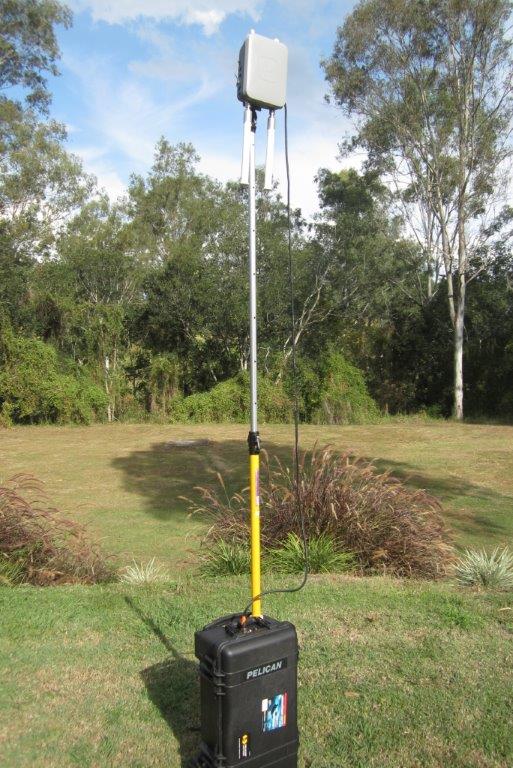
- Battery Powered AP Rigs: APs are configured with pre-designated power levels and run on batteries (this is the AP-on-a-stick).
- Site Survey: With the APs in location, an onsite survey is conducted, which allows for the Predictive Design to be tested in-situ - before the APs are cabled
- Design Refinement: Based on the results, the original Wi-Fi Predictive Design is updated. if the walls were thicker or thinner in reality than the original design, the design is updated based upon the Pre-deployment Survey results.
The pre-deployment survey really helps test the design in the real world.
The building fabric can make a big difference to the layout and density of APs, so this onsite real-world testing provides the ability to refine and confirm the design before any cabling is installed.
Shown in the image is one of the battery powered pre-deployment rigs we use (this one is prepped for an external survey, with an external AP in use).
The Access Point type is changed to the relevant AP used for the design, so the design is tested with the correct AP variant.
The final stage in the Wi-Fi deployment process is the deployment validation survey. This survey confirms that once the Wi-Fi has been enabled and allowed to tune that it's working within the design parameters - that means it can auto-tune from this point giving you peace of mind you'll have the best in Wi-Fi experience for years to come.
Wi-Fi Deployment Validation Survey
Once the design is complete (via the two stage process of the Wi-Fi Predictive Survey and the Wi-Fi Pre-deployment survey), the network can be installed and commissioned.
The use of the two stage design (desktop based, followed by real world testing), allows for the design to be refined. Once installed and operational, the network should be tuned.
The tuning is a pretty important stage in itself and following this, the post Deployment Validation Survey is conducted.
The survey is typified by;
- Onsite Survey: Walkround survey covering 100% of the areas to be operational with Wi-Fi
- Report: Report details the findings from the survey, including any issues identified
The report includes the heatmaps from the Primary and Secondary coverage across the 6GHc, 5GHz and 2.4GHz bands.
.gif?width=1080&height=1080&name=Deployment%20Validation%20Survey%20%E2%80%93%20What%20to%20Expect%20(Instagram%20Post).gif "Deployment Validation Survey – What to Expect (Instagram Post)")

Know What You Need? Get It Quoted
Once your survey is done, we can supply the access points, switches and licences it calls for.
From the Blog
Wi-Fi Design Insights From the IPTel Blog
How we design, survey and validate enterprise Wi-Fi.
 IPTel BlogHigh-Availability Hospital Wi-Fi DesignDesigning for coverage, redundancy and clinical devices.
 IPTel BlogWi-Fi Design 101The requirements to settle before you design.
.gif?width=760&height=380&name=Pre-Deployment%20Wireless%20Survey%20(Instagram%20Post).gif) IPTel BlogPre-Deployment Wireless Survey: What to ExpectTesting the design onsite with real access points.
IPTel BlogPre-Deployment Wireless Survey: What to ExpectTesting the design onsite with real access points.
.gif?width=760&height=380&name=Deployment%20Validation%20Survey%20%E2%80%93%20What%20to%20Expect%20(Instagram%20Post).gif) IPTel BlogDeployment Validation Survey: What to ExpectHow we prove the finished network performs.
IPTel BlogDeployment Validation Survey: What to ExpectHow we prove the finished network performs.
.gif?width=760&height=380&name=Wi-Fi%20Predictive%20Design%20(Instagram).gif) IPTel BlogWi-Fi Predictive Design and HeatmapsWhere every good Wi-Fi design starts.
IPTel BlogWi-Fi Predictive Design and HeatmapsWhere every good Wi-Fi design starts.
.gif?width=760&height=380&name=Wireless%20Design%20-%20Cheapest%20or%20Best%20Value%20(Instagram).gif) IPTel BlogCheapest vs Best Value Wi-Fi DesignWhy the cheapest design rarely costs the least.
IPTel BlogCheapest vs Best Value Wi-Fi DesignWhy the cheapest design rarely costs the least.

4/7 Camford Street
Milton, Queensland
4064, Australia
Level 27, 101 Collins Street
Melbourne, Victoria
3000, Australia
Phone: 1300 048 733
Email: sales@iptel.com.au
ABN: 95 118 836 534

© Copyright 2026 | IPTel Solutions | All rights reserved

.png)
.png)
